
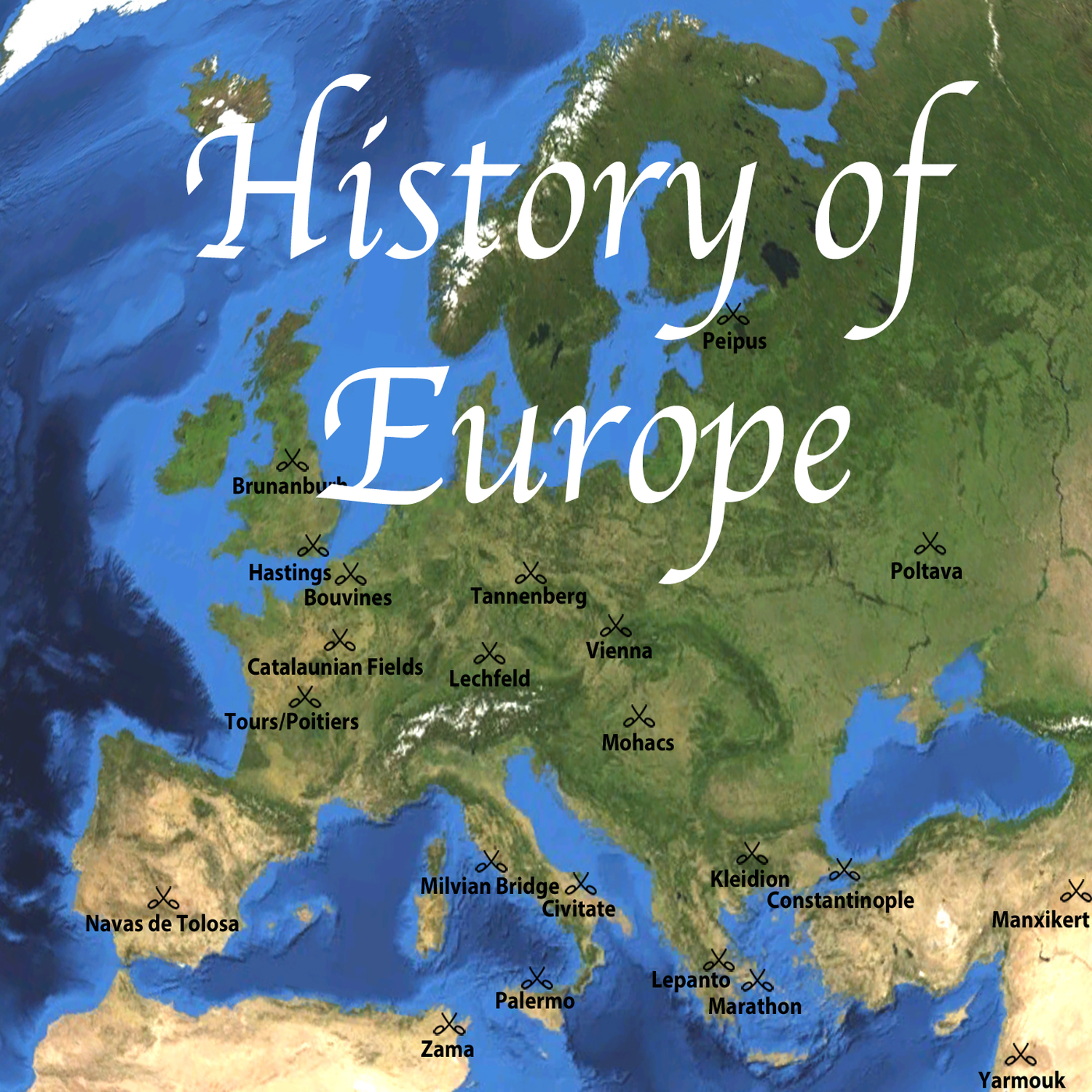
A podcast on European conflicts from the perspective of each side to provide an alternative to the traditional national narratives. Going chronologically from the Ancient Greeks onwards I described to some extent how each battle was won or lost by particular decisions, tactics, technology or fortune. But the aim of each main narrative will be to place each battle in the context of the overall history of Europe.New series on the Interwar Years 1918-1945 begins 18th July 2025 Hosted on Acast. See acast.com/privacy for more information.
International negotiations lead to the Kellogg-Briand pact, bringing hope for eternal peace in Europe. However, Germany suffers the double blow of its most able statesman Gustav Stresemann, together with the economic fallout of the Wall Street Crash. Political instability leads to President Hindenburg choosing his own cabinet and so sideline parliament. Hitler's Nazi party break through in elections in September 1930 Picture: Gustav Stresemann signing the Kellogg-Briand pactwww.historyeurope.netwww.patreon.com/historyeuropehttps://podcasts.apple.com/us/podcast/a-history-of-europe-key-battles/id788893946Opening Music: The Charlston. End Music by Nico Vettese Hosted on Acast. See acast.com/privacy for more information.
President Ebert dies of illness, prompting a presidential election, which is won by the former WW1 military commander Paul von Hindenburg. International negotiations continue, culminating in the Treaty of Locarno, in which France, Germany and Belgium agreed never to attack each other again. Germany joins the League of Nations, and Hitler re-asserts his authority over the National Socialist Party.Picture: President Paul von Hindenbergwww.historyeurope.netwww.patreon.com/historyeuropehttps://podcasts.apple.com/us/podcast/a-history-of-europe-key-battles/id788893946Opening Music: The Charlston. End Music by Nico Vettese Hosted on Acast. See acast.com/privacy for more information.
Post World War One Germany Struggles to pay the reparations demanded in the Treaty of Versailles.Picture: President Ebert asked Gustav Stresemann, leader of the DVP party, who formed a government coalition in 1923www.historyeurope.netwww.patreon.com/historyeuropehttps://podcasts.apple.com/us/podcast/a-history-of-europe-key-battles/id788893946Opening Music: The Charlston. End Music by Nico Vettese Hosted on Acast. See acast.com/privacy for more information.
The early years of Adolf Hitler as he becomes politically active and joins the Nazi party. Meanwhile the Weimar Republic struggles with harsh post-war conditions and attempted uprisings from both the Left and Right.Photo: German police sent to put down a left-wing rebellion known as the March Actionwww.historyeurope.netwww.patreon.com/historyeuropehttps://podcasts.apple.com/us/podcast/a-history-of-europe-key-battles/id788893946Opening Music: The Charlston. End Music by Nico Vettese Hosted on Acast. See acast.com/privacy for more information.
After World War One, political upheaval in Germany leads to the overthrow of the German monarchy and establishment of a new republic based in the town of Weimar.Photo: Proclamation of Weimar Republic, 9 November 1918.www.historyeurope.netwww.patreon.com/historyeuropehttps://podcasts.apple.com/us/podcast/a-history-of-europe-key-battles/id788893946Opening Music: The Charlston. End Music by Nico Vettese Hosted on Acast. See acast.com/privacy for more information.
Mussolini consolidates his control of Italy, using a combination of intimidation, violence and occasional compromise to establish an authoritarian regime. He introduces a number of projects to boost Italy, including strengthing the currency, agricultural refor, after-work clubs and family planning, with mixed results. He also embarked on an expansionist foreign policy.Picture: Mussolini with the fascist youthOpening Music: The Charlston. End Music by Nico Vettesewww.historyeurope.netwww.patreon.com/c/historyeuropehttps://podcasts.apple.com/us/podcast/a-history-of-europe-key-battles/id788893946 Hosted on Acast. See acast.com/privacy for more information.
After World War One Italy suffered social unrest due to economic hardship and nationalism. Benito Mussolini led a new Fascist movement which took power in the March on Rome in October 1922Picture: Benito MussoliniOpening Music: The Charlston. End Music by Nico Vettesewww.historyeurope.netwww.patreon.com/c/historyeuropehttps://podcasts.apple.com/us/podcast/a-history-of-europe-key-battles/id788893946 Hosted on Acast. See acast.com/privacy for more information.
A delegation from Ireland meet the British and make an agreement for Irish autonomy but makes a compromise to keep under under the British Crown.The Irish break into two sides, one supporting the treaty, one opposing it and demanding full independence and a republic. The ensuing Irish Civil War left a bitter legacy.Picture: Bombing of the Four CourtsOpening Music: The Charlston. End Music by Nico Vettesewww.historyeurope.netwww.patreon.com/c/historyeuropehttps://podcasts.apple.com/us/podcast/a-history-of-europe-key-battles/id788893946 Hosted on Acast. See acast.com/privacy for more information.
The Irish form a shadow government in opposition to the British, with their own courts and tax collections. Meanwhile, Irish volunteer fighters wage guerilla warfare against the British police force, the Royal Irish Constabulary.Picture: West Connemara Flying ColumnOpening Music: The Charlston. End Music by Nico Vettesewww.historyeurope.netwww.patreon.com/c/historyeuropehttps://podcasts.apple.com/us/podcast/a-history-of-europe-key-battles/id788893946 Hosted on Acast. See acast.com/privacy for more information.
In January 1919 a group of recently elected Sinn Fien MPs gathered in Dublin. There they proclaimed the establishment of an Irish Republic and adopted a ‘Declaration of Independence’, which asserted Ireland’s right to be a sovereign nation. I describe here the background to the Irish people's struggle for independence from the United Kingdom, including the Easter Rising 1916.Picture: Royal Irish ConstabularyOpening Music: The Charlston. End Music by Nico Vettesewww.historyeurope.netwww.patreon.com/c/historyeuropehttps://podcasts.apple.com/us/podcast/a-history-of-europe-key-battles/id788893946 Hosted on Acast. See acast.com/privacy for more information.
An overview of the situation across Europe after World War One. The Treaty of Versailles. The post-war division of territories. The German Revolution and the question of financial reparations.Picture: The heads of the "Big Four" nations at the Paris Peace Conference, 27 May 1919. From left to right: David Lloyd George, Vittorio Orlando, Georges Clemenceau, and Woodrow WilsonOpening Music: The Charlston. End Music by Nico Vettesewww.historyeurope.nethttps://podcasts.apple.com/us/podcast/a-history-of-europe-key-battles/id788893946 Hosted on Acast. See acast.com/privacy for more information.
Conclusion of the Turkish National Struggle 1919-1922. Mustafa Kemal, later known as Ataturk, leads the Turkish Nationalists against the armies of Greece.The Battle of Sakarya River between the Turks and Greeks is a key battle of European history and shapes of the future of their respective countries.Picture: Inferno of SmyrnaMusic: The Charlston Hosted on Acast. See acast.com/privacy for more information.
Turkish National Struggle 1919-1922The Ottoman Empire emerges defeated from World War One. The Entente Allies impose harsh conditions in the armistice whereby the Ottomans lose most of their territory including parts of Anatolia. However, Mustafa Kemal, later known as Ataturk, raises an army to oppose the AlliesPicture: Mustafa Kemal and Turkish soldiers Hosted on Acast. See acast.com/privacy for more information.
As background to the Turkish National Struggle, this episode describes the events in the Caucasus Mountains in World War One, - conflict between Russia, the Ottoman Empire, the Germans, and nationalist groups of Georgians, Armenians and Azerbaijanis.Separately I talk about Greece's involvement in World War One.Picture: Kaiser Wilhelm of Germany and Enver Pasha, Minister of War for the Ottoman Empire Hosted on Acast. See acast.com/privacy for more information.
The Ottoman Empire in World War One - the fights for the Suez Canal, Gaza, Jerusalem and Arabia between the British and TurksPicture: General Allenby enters Jerusalem Hosted on Acast. See acast.com/privacy for more information.
In 1920 the Polish and Soviet Russian armies clashed in a series of battles across a wide area of eastern Europe including Ukraine and Lithuania.The Soviets advanced deep into Poland and reached the gates of Warsaw, with the aims of capturing the city and., more widely, exporting their revolution across Europe.Picture: Polish soldiers in the Battle of Warsaw 1920 Hosted on Acast. See acast.com/privacy for more information.
The Polish Army make a pre-emptive strike against Soviet Russia. They invade the eastern borderlands, and take large amounts of territory, especially in Ukraine, but they fail to break the Russian army. Meanwhile, the Ukrainians attempt to form an administration in KyivPicture: Vladimir Lenin rallying his people to the warIntro Music: The Charlston Hosted on Acast. See acast.com/privacy for more information.
While Western Europe's borders were settled post World War One, fighting still raged elsewhere on the continent. The most significant was the Polish Soviet War, which raised issues such as the clash of ideologies, the Soviets’ attempt to export their revolution, the future of Europe itself.It was a conflict that spanned a large area, from Lithuania and Ukraine in the east to Warsaw in the west.Picture: Josef Pilsudksi with soldiers Hosted on Acast. See acast.com/privacy for more information.
The Bolsheviks face numerous opponents across Russia, and struggle to gain control of all lands of the old Tsarist Empire.The White anti-Bolsheviks make a plan to move on Moscow www.historyeurope.netwww.patreon.com/historyeuropePicture: By Hoodinski - Own work, CC BY 3.0, https://commons.wikimedia.org/w/index.php?curid=16761719 Hosted on Acast. See acast.com/privacy for more information.
Civil War rages across Russia from the north in Murmansk, across the Trans-Siberian Railway to the Far East, as well as in Ukraine and the Caucasus. However, the anti-Bolshevik fail to cooperate effectivelyPicture: Tsar Nicholas II with this family 1913 (murdered by the Bolsheviks in July 1918) Hosted on Acast. See acast.com/privacy for more information.
The new Bolshevik regime quickly gains control of most of former Russia Empire, but meets stiff resistance in the periphery including Finland, the Caucasus and Ukraine.They sign a peace treaty with Germany at Brest-Litovsk and withdraw from the First World WarPicture: Volunteer Army Infantry Hosted on Acast. See acast.com/privacy for more information.
- Introduction to the new series on the Interwar Years- A recap of Russia's involvement in the First World War- The February 1917 Revolution and Provisional Government - Lenin's Bolsheviks seize power in the October Revolution www.historyeurope.nethttps://www.patreon.com/c/historyeurope Hosted on Acast. See acast.com/privacy for more information.
The Battle of Lake Peipus or 'The Battle on the Ice' was fought on 5th April 1242 between a coalition of western crusaders led by the Teutonic Knights against an army from Novgorod, Russia, led by Alexander Nevsky. The conflict was made famous by a Soviet film of 1938 directed by Sergei Eisenstein.This is the fifth and final part of a set of episodes on the Medieval Baltic and the Northern Crusades Hosted on Acast. See acast.com/privacy for more information.
Alexander Nevksy appointed Prince of Novgorod, a Russian city with its own unique culture and proud history.Lead up to Battle of Lake Peipus 1242 Hosted on Acast. See acast.com/privacy for more information.
Livonia in the 12th century was threatened by invasion from all sides; Danes, Swedes, Germans, Poles and Russians. Key events in the episode;1201 - Founding of Riga (capital of modern day Latvia) by Bishop Albert1219 - Capture of Tallinn (capital of modern day Estonia) by Denmark in the legendary battle of Lyndaniss1236 - Defeat of a military order, the Sword Brothers, by a band of Lithuanians at the Battle of Saule Hosted on Acast. See acast.com/privacy for more information.
The Teutonic Order was set up in the Holy Land as a German equivalent of other military orders. The first campaigns in Europe were in response to invitations from the King of Hungary and then a Duke of Poland. And so began their conquest of Prussia Hosted on Acast. See acast.com/privacy for more information.
The geography and early history of the Baltic Sea. Also the beginnings of the Northern Crusades against the Baltic pagans. The first major campaign is the Wendish Crusade of 1147 Hosted on Acast. See acast.com/privacy for more information.
A special episode where I interview Stuart E Eizenstat - an American diplomat and attorney. Mr Einzenstat worked on Jimmy Carter's 1976 presidential campaign. After winning said campaign he became President Jimmy Carter’s Chief Domestic Policy Adviser.Later he went on to become President Bill Clinton's Deputy Secretary of the Treasury. And he served as the United States Ambassador to the European Union from 1993 to 1996Mr Eizenstat has also devoted much effort to various aspects of Holocaust Restitution, successfully negotiating major agreements with the Swiss, Germans, Austrian and French, and other European countries. He has recently written a book called the Art of Diplomacy in which he recounts how American negotiators reached historic agreements that changed the world.https://www.amazon.co.uk/Art-International-Diplomacy-Stuart-Eizenstat/dp/1538167999 Hosted on Acast. See acast.com/privacy for more information.
The Paris Peace consisted of a group of distinct treaties, but the main concern of the delegates was the settlement with Germany, embodied in the Treaty of Versailles signed in June 1919.Germany’s eastern frontiers presented far greater problems. www.patreon.com/historyeuropewww.historyeurope.netMusic composed by Edward Elgar, Enigma variations, Variation IX (Adagio) NimrodPicture - Treaty of Versailles, Big FourTheme tune for the podcast by Nico Vettese, www.wetalkofdreams.com Hosted on Acast. See acast.com/privacy for more information.